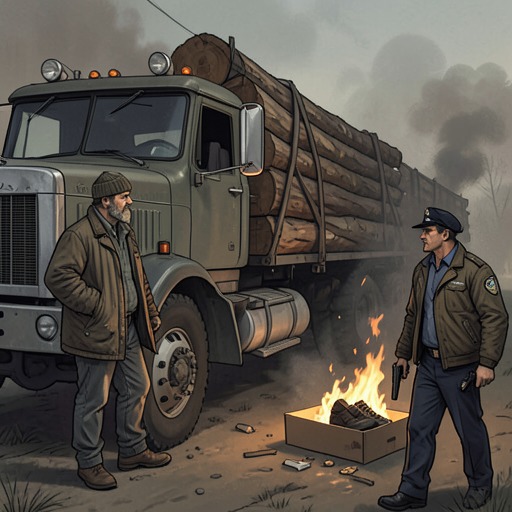
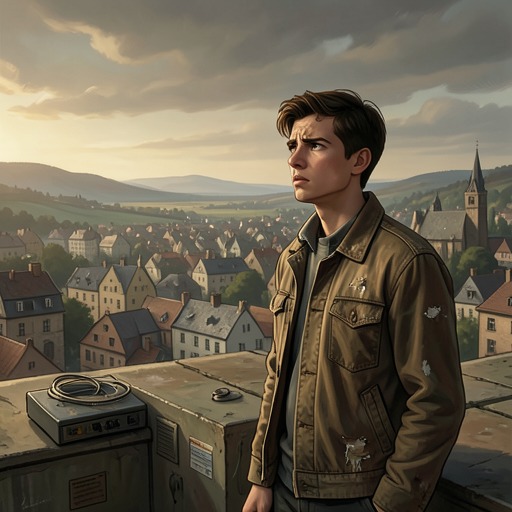
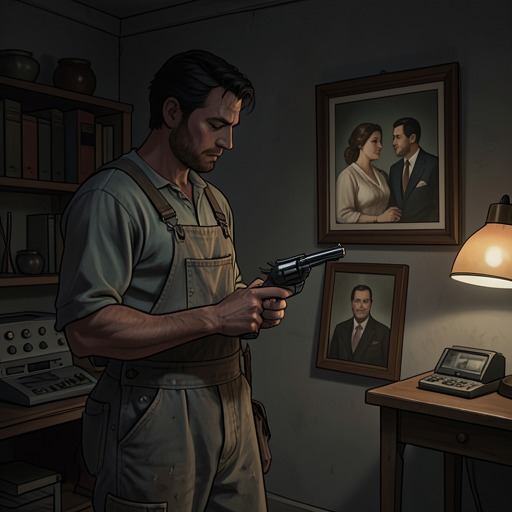
Event 1
米勒斯堡一家遇害案
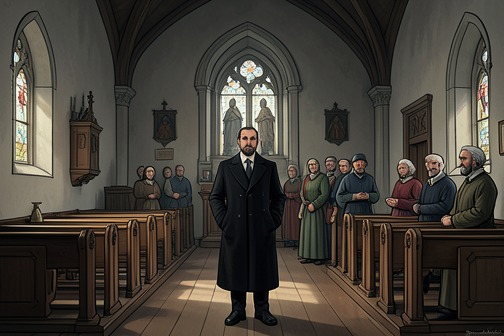
The Millersburg family murders are a brutal, unresolved crime remembered through preaching, local rumor, and the investigation into [Helen Laferty](entity:character-recall-character-helen-laferty-5d39e8414aee)’s disappearance. Their significance extends beyond the unknown identity of the killer: the murders become a vivid example of damnation in [Roy Laferty](entity:character-recall-character-roy-laferty-e16547d39a08)’s sermon, then a possible link in the sheriff’s uncertain account of other missing people.
## The crime in public memory
At a service in [Coal Creek](entity:location-recall-location-coal-creek-dcef26748dc1), Roy Laferty invokes the family’s murder in Millersburg to make the torments of hell imaginable to his congregation. He recalls that the victims were killed in their beds and uses the crime to warn that earthly violence cannot compare with the eternal punishment he associates with Judgment Day. The sermon turns a recent local atrocity into a means of frightening listeners and pressing the urgency of religious salvation. It offers no identification of the killer or explanation of the crime, leaving the family’s fate as a haunting reference rather than a solved case.
## The investigation and its uncertain links
The murders resurfaced in the investigation after ginseng hunters found Helen Laferty’s remains in the woods a few miles from Coal Creek. [Willard Russell](entity:character-recall-character-willard-russell-2cf8dcdee6b2) received the news from his mother in a letter and reread it nightly for a week. Nearly three years had passed without any sign of Roy Laferty or [Theodore Daniels](entity:character-recall-character-theodore-daniels-047916ab6d60), who were the sheriff’s prime suspects in Helen’s disappearance; the sheriff could not determine whether they were still alive or had also been killed and left elsewhere. He considered whether the same person responsible for the Millersburg murders might have killed Helen and disposed of the two men, but this remained speculation, not a solved connection. [Emma Russell](entity:character-recall-character-emma-russell-5fccfe6de48b), by contrast, was convinced Roy and [Theodore](entity:character-recall-character-theodore-004f188c5d42) were alive and guilty, and would not rest until they were imprisoned or dead. The contrast between the sheriff’s unresolved possibilities and [Emma](entity:character-recall-character-emma-0b5c09f9ac66)’s certainty keeps the murders entangled with the town’s fears about other disappearances without establishing who committed either crime.
## A landmark in local conversation
The murders also serve as a local point of reference beyond the church service. When Emma Russell asks Helen Laferty where Roy Laferty is waiting, Helen explains that he is preaching in Millersburg, identifying the place through the family whose deaths had become known there. She adds that she and Roy had spent the morning gathering spiders. The exchange offers no new account of the crime, but shows how its notoriety had entered ordinary conversation: Millersburg could be recognized through the violence associated with it, even by someone speaking about the practical business of a traveling preaching visit.
## Fear beyond the case
The unresolved murders formed part of the violent news surrounding Willard Russell’s family. After learning that Helen Laferty’s remains had been found, [Willard](entity:character-recall-character-willard-141299ec5391) reread his mother’s letter night after night; [Charlotte](entity:character-recall-character-charlotte-45ddf3085f55) noticed that reports of the case and other violence were making him increasingly distressed. The sheriff’s suggestion that the Millersburg killer might also have killed Roy Laferty and Theodore Daniels remained only a possibility, but the uncertainty sharpened Willard’s fear that something might happen to his own family. He felt an urge to pray after years of silence toward God, yet believed he could not do so in the cramped apartment or inside a church. His decision that the family had to leave therefore grows from a surrounding climate of violence and dread, rather than from any proven connection between the murders and Helen’s death.
Event 2
威拉德·罗素自杀
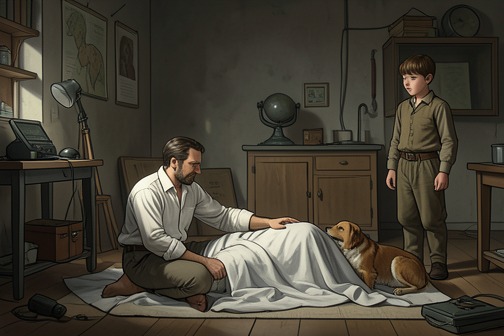
[Willard Russell’s suicide](entity:action-recall-action-willard-russell-s-suic-6e72687cf25c) follows the death of his wife, [Charlotte](entity:character-recall-character-charlotte-45ddf3085f55), and ends the prayer vigil he had imposed on his son, Arvin. At the prayer log, Arvin finds his father dead after declaring that he will no longer pray. The scene binds grief, failed faith, and the father’s earlier dependence on prayer into a single rupture; its immediate aftermath shows the boy leaving the woods and seeking help from [Hank Bell](entity:character-recall-character-hank-bell-0cb4d33779f9).
## Background and the Failed Vigil
During Charlotte’s final illness, [Willard](entity:character-recall-character-willard-141299ec5391) made Arvin pray for her recovery, insisting that the boy continue until he returned. Arvin obeyed through the night, although he recalled having once wished his mother dead and ran faster as he thought of it. By three in the morning his voice was nearly spent. Willard returned once to pour water over him and urge him to continue, while people in [Knockemstiff](entity:location-recall-location-knockemstiff-c2194d5d49ce) responded in different ways: some shut their windows, and others stayed awake and prayed themselves. Arvin’s vigil offered no relief that he could perceive, and his appeal to the dead dog [Jack](entity:character-recall-character-jack-b5a26722c3ea) made the scene’s helplessness plain without changing its course.
Charlotte died before dawn. Willard covered her with a clean sheet and went to the prayer log, where he listened to Arvin’s exhausted prayers. He had an open penknife in his hand, but, on recognizing it, put it away and spoke gently to his son for the first time in weeks. That moment matters in retrospect: the knife is present before the suicide, but Willard does not use it then. He instead tells Arvin that his mother is gone, ending the vigil only after the loss it was meant to prevent has become irreversible.
## Burial and the Return to the Log
Charlotte was buried two days later in the small cemetery outside Bourneville. On the way home, Willard suggested taking Arvin to [Coal Creek](entity:location-recall-location-coal-creek-dcef26748dc1) to visit his grandmother and meet his uncle, [Earskell](entity:character-recall-character-earskell-c64bccd61d49), and a girl of about Arvin’s age. Arvin did not answer. He remained attached to his mother and was certain he could not recover from her death; his father’s earlier assurances that prayer would make her well had proved false. A blueberry pie left on the porch offered a practical kindness, but did not resolve the family’s grief. Willard went out into the field, while Arvin rested and later sat in Charlotte’s rocking chair.
That evening Arvin went looking for his father. After checking the barn, he headed to the prayer log, which neither had visited since Charlotte’s death. There he found Willard kneeling. Arvin told him that he would not pray anymore, a refusal he understood might provoke trouble but made anyway. The declaration marks a change in the boy’s position: he no longer accepts the ritual that his father had treated as an obligation, or the promise that sustained it.
## Discovery and Death
When Willard did not answer, Arvin moved closer and touched his shoulder. The penknife fell to the ground, and Arvin saw that his father had died by suicide. Willard’s earlier decision to put the knife away had therefore been followed by a later return to it, after Charlotte’s burial and after the prayer vigil had ended. The narrative gives no further explanation of his decision; it places the death amid his grief and despair without reducing it to a stated motive.
Arvin stood beside the body and looked toward the lights of Knockemstiff. He felt guilty and ashamed that he was not crying, but understood his mother’s prolonged dying to have left him with no tears. The narration recalls that the hunters had once come upon Willard and Arvin at this same clearing, making the prayer log a repeated setting in the boy’s life: first a place where his father demanded hope, now the place where that hope and his father both end. Arvin could not undo what had happened. He stepped around Willard and made his way down through the woods.
## Reporting the Death
Arvin reached Hank Bell’s store carrying a flashlight. [Hank](entity:character-recall-character-hank-79d5809e13b8) had closed Maude’s store and was outside listening to a baseball game when he noticed the boy crossing Clarence’s pasture. He had not previously seen Arvin away from the hill by himself and knew that Charlotte had been buried that afternoon. The boy looked pale and unwell, and Hank offered to reopen the store if he needed something. Instead, Arvin asked how to reach the law and then asked Hank to make the call, explaining that he had never used a telephone.
Hank asked what he wanted with the sheriff. Arvin answered that someone was dead. When Hank assumed he meant Charlotte, Arvin corrected him: it was his father. He explained that his mother had been dead for three days. This brief exchange establishes the sequence for the listener as well as the fact of Willard’s death: the bereavement that brought the family to the prayer log preceded the suicide, and Arvin has now become the person responsible for telling someone outside the family what happened.
## Narrative Significance
The suicide reverses the purpose of the prayer log. Willard had used it to make Arvin plead for Charlotte’s life, but after her death the same place becomes the site where Arvin rejects prayer and discovers his father’s body. The reversal does not prove that faith itself caused Willard’s death; rather, it shows how the family’s practice of prayer was tied to a hope that could not be fulfilled. Arvin’s refusal is immediately followed by a discovery he cannot change, while his next action is practical: he leaves the woods and asks Hank to contact the law.
The event also separates the child from the promises that had organized his parents’ response to suffering. Willard’s earlier reassurance that prayer could save Charlotte is contradicted by her death, and Willard himself is no longer present to explain what prayer or loss means to him. Arvin’s exhausted silence at the body, followed by his clear report to Hank, gives the scene its restrained aftermath: grief is present, but the narrative registers it through the failed vigil, the boy’s lack of tears, and the necessity of asking for help.
Event 3
Roy’s encounter with Carl and Sandy
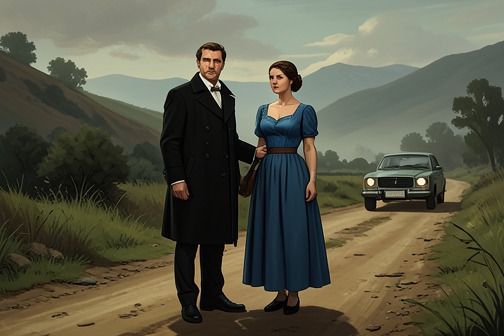
[Roy’s encounter with Carl and Sandy](entity:event-recall-event-roy-s-encounter-with-ca-bf2175e8cadc) is a failed attempt to draw a hitchhiker into their exploitative photographic scheme. When Roy refuses and Carl threatens him with a gun, the scene briefly makes survival depend on Roy’s resolve and on the revelation of a life beyond the road: he has a daughter named Lenora. The couple’s failure to capture him stands in sharp contrast to their established pattern of treating isolated travelers as targets.
## Background and Setup
[Carl Henderson](entity:character-recall-character-carl-henderson-7a9cb37a060f) and [Sandy Henderson](entity:character-recall-character-sandy-henderson-1a968f15cb32) have spent years roaming in search of hitchhikers. They travel in a black Ford station wagon bought for one hundred dollars at Brother Whitey’s used-car lot in [Meade, Ohio](entity:location-recall-location-meade-ohio-0e2bbb0d70cf), and regard the people they pick up as potential subjects for Carl’s photographs. Their roles are deliberately divided: [Sandy](entity:character-recall-character-sandy-457b75877fae) draws travelers in, while Carl controls the camera and the encounter. Earlier that same evening, north of Hannibal, Missouri, they had killed a young enlisted man. The meeting with Roy therefore occurs within an ongoing pattern of predation, not as an isolated lapse in judgment.
The couple’s photographic routine is also established by their treatment of an Iowa hitchhiker. At a garbage dump, Carl set up a sexual proposition and took at least twenty photographs before killing the young man. The episode shows that the camera is not incidental: it is part of a practiced method in which Sandy’s apparent participation helps create an opportunity for Carl to control and exploit the traveler. Roy’s encounter follows the same broad design, though its outcome is different.
Roy has been traveling on foot and by rides for an uncertain number of days, perhaps three. He is exhausted and has little sense of how much farther he can go. After he is picked up, he falls asleep in the car. Carl consults a Georgia highway map, then directs Sandy off the road and down a dusty clay lane. They stop at a pull-off scattered with party trash and a broken piano. The isolated site removes the encounter from ordinary traffic and gives Carl room to stage the scene.
## The Proposition and Roy’s Refusal
Carl wakes Roy and leads him toward a stand of loblolly pines. He carries a pistol and a camera; Sandy begins to undress, and Carl presents the arrangement as an offer for Roy to have sex with his wife while he takes photographs. The proposal disguises coercion as a bargain. In the car, Sandy had already said she would not actually have sex with the hitchhiker, making clear that her part in the performance is bait rather than consent to the arrangement Carl describes.
Roy is confused at first, then understands that Carl is serious. He refuses. He tells Sandy that, after [Theodore Daniels](entity:character-recall-character-theodore-daniels-047916ab6d60) died, he promised himself he would live right, and he intends to keep that promise. His answer gives the refusal a moral and personal context: Roy is not simply rejecting a stranger’s proposition but trying to hold to a commitment made after losing his companion. Sandy urges him to cooperate, but Roy instead emphasizes how worn down he is and questions whether she would truly want contact with him. The exchange interrupts the couple’s practiced script; their attempt to make the scene seem like an invitation does not persuade him.
Roy also refers to the last woman he was with as a bird, saying [Theodore](entity:character-recall-character-theodore-004f188c5d42) had been afraid of her. The statement reflects the disordered religious and fantastic perceptions surrounding Roy and Theodore’s earlier life together. Carl treats it as proof that Roy is irrational, laughing and dismissing him as a fool. Sandy, meanwhile, stops the performance and begins to dress again. For a moment the couple appears ready to abandon the encounter, but Carl’s control of the situation has not ended.
## Threat and Revelation
As Roy watches Sandy walk back toward the car, Carl presses the barrel of the gun against the side of his head and warns him not to run. Roy answers that his running days are over. He looks through the branches toward a small patch of sky and imagines death as a kind of floating away. The scene brings his exhaustion into direct contact with the immediate threat, but he does not plead or attempt to escape.
Before Carl can act, Roy asks for a moment and names his daughter: [Lenora Laferty](entity:character-recall-character-lenora-laferty-4d0ec457365f). When Carl demands to know whom he means, Roy clarifies that Lenora is his little girl. The disclosure changes the meaning of his refusal. The promise to live right is not only a private response to Theodore’s death; Roy’s words also identify a surviving family bond, even though Lenora is not present and he has been separated from her. The brief naming of his daughter cuts through Carl’s ridicule and the couple’s attempt to reduce Roy to a disposable hitchhiker.
## Aftermath and Significance
The encounter ends without Carl killing Roy. Later, Carl dwells on the trip’s failures, including the ex-con who got away, and concludes that the photographs he took on this outing were mostly poor. He had spent the night turning over possible signs and blaming Sandy’s attitude as well as the missed opportunity. He swears that he will not hunt in the South again. The account links Roy’s escape to Carl’s frustrated review of the trip, while showing that Carl interprets failure through his own fixation on signs and photographic results rather than through any recognition of the harm he intended.
The incident also clarifies the difference between Carl’s rules and the violence that sustains them. Later, near the Ross County line in [Ohio](entity:location-recall-location-4c66c89ead05), he considers killing a hitchhiker there despite having never broken one of his major rules before. That later decision is not part of Roy’s encounter, but it echoes the couple’s shifting geography and Carl’s habit of treating rules as adjustable when an opportunity presents itself. In Roy’s scene, however, the planned photographic capture fails: his refusal, his insistence on his promise, and his final revelation of Lenora leave Carl without the victim he expected to control.
Event 4
Arvin’s killing of Carl and Sandy
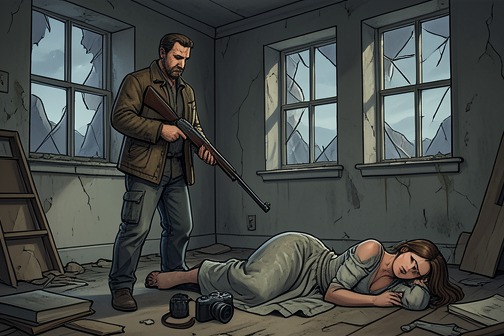
[Arvin’s killing of Carl and Sandy](entity:event-recall-event-arvin-s-killing-of-carl-d3744bb671f0) ends the couple’s attempt to turn another hitchhiker into a subject for their murder photographs. What begins as a ride toward [Meade](entity:location-recall-location-144b92fe38b8) becomes a trap at an abandoned house; Arvin’s refusal to cooperate gives way to armed self-defense, and the encounter leaves him fleeing with evidence of the couple’s crimes.
## The couple’s method
[Carl Henderson](entity:character-recall-character-carl-henderson-7a9cb37a060f) and [Sandy Henderson](entity:character-recall-character-sandy-henderson-1a968f15cb32) approach strangers through an easy performance of ordinary sociability. [Sandy](entity:character-recall-character-sandy-457b75877fae) handles the conversation and flirts with the men they pick up, while Carl watches and waits to bring out his camera. He presents the Leica M3 as a photographer’s tool, boasting about its price and describing the pictures he takes with Sandy. The pose of casual artistry conceals a routine built around luring, killing, and photographing their victims.
Their partnership predates the [Ohio](entity:location-recall-location-4c66c89ead05) encounter. Carl first met Sandy when she was an eighteen-year-old waitress at the [Wooden Spoon](entity:location-recall-location-wooden-spoon-ae86c8be5ee3) in Meade; he had recently lost his mother and imagined taking her picture before he understood what that impulse would become. They stayed together, with Sandy eventually helping to put prospective victims at ease. Her part in the routine does not mean she shares Carl’s view of it without reservation: she knows the camera was no bargain in the sense that matters, and that their shared life will exact its cost.
The photographs make the crime more than a series of concealed killings. Carl regards the victims’ final fear as the moment when they stop pretending, and therefore as material for a picture. In a private viewing ritual, he sits with a shoebox of more than two hundred photographs, studies them one by one, and tries to guess each image before briefly shining a flashlight on it. He remembers the last moments of twenty-four men. The camera and archive preserve the couple’s control over their victims beyond the immediate act, while turning the victims into objects in Carl’s private collection.
## A planned violation of Carl’s rules
On the day of the encounter, Carl and Sandy are traveling as vacationers from [Fort Wayne](entity:location-recall-location-9e946c2cd105) after a trip to [Florida](entity:location-recall-location-7145a4a461e6). Near the Ross County line, Carl checks his watch and calculates that Meade is about ten miles away, with roughly ninety minutes of good light remaining. He knows a safe place nearby and decides to kill a man in Ohio, despite having kept to his major rules before. The decision is a deliberate breach of his own system, made under the pressure of time and the opportunity presented by their passenger.
The couple stop at the remains of a driveway beside a long-abandoned house. Its broken windows, failing porch, and open front door offer a secluded setting; across the road, drought has left the cornfield yellow and withered. Once Sandy stops the car, Carl takes the camera from the glove compartment and introduces himself to Arvin as a photographer. He asks to photograph Arvin with Sandy, then proposes that she pose naked. Arvin declines. He says he wants to keep moving and get to Meade, then begins to leave the car rather than submit to the request.
Carl’s apparent retreat is a feint. He says he will urinate and get back on the road, but then orders Arvin out of the car at gunpoint. Arvin has a [Luger pistol](entity:object-recall-object-luger-pistol-857615e06753) concealed in the waistband of his overalls. He offers Carl money, but the offer does not end the threat: Carl says the money can wait until after the photographs. Sandy warns Arvin that Carl becomes excited when things do not go his way. Her shaking hands as she tries to light a cigarette, followed by her participation in the threat, make the shift from staged friendliness to danger unmistakable.
## The shooting
Arvin acts before Carl can use his weapon. He shoots Carl twice, and Carl falls in the weeds, unable to continue the confrontation. The narration briefly follows Carl’s fading awareness: he imagines that he might still repair the situation and stop the killings, then loses the ability to respond. His thought of an end to the photographs arrives only as he is dying, too late to alter the pattern he helped create.
Sandy screams Carl’s name and reaches into her purse. Arvin tells her not to draw anything and pleads with her to stop. She quiets, looks down at Carl, and then decides to fire. Her .22 misses Arvin. Before she can fire again, he shoots her, and she dies at the scene. The exchange is not presented as a planned reprisal: Arvin first tries to keep her from reaching for a weapon, and fires when she attacks him.
The immediate aftermath is disorienting rather than triumphant. Arvin vomits, feels despair, and paces before approaching Carl. He searches the dead man’s wallet and finds a photograph showing Sandy cradling a dead man. The image identifies the couple’s photographic practice as part of a prior killing, not merely a threat they had made to Arvin. He puts the photograph in his shirt pocket and leaves the wallet on Carl’s chest.
## Escape and the surviving evidence
Arvin checks the glove compartment, finding road maps and rolls of film, and listens for approaching cars. He knows he has to leave quickly. Carrying his gym bag, he walks west through the parched corn rows, then turns back to take two film canisters from the car. Before leaving again, he uses a shirt to wipe the surfaces he may have touched. The small, practical acts mark the scene’s change in stakes: after killing the couple, he must avoid being identified and escape with whatever evidence he can carry.
He stays off the roads and reaches Meade after midnight. There he finds a room at the [Scioto Inn](entity:location-recall-location-scioto-inn-707b6a0cb3f1), a squat brick motel near Main Street, and begins a night away from the scene. The killings have not ended the threat of discovery, but the photograph and film canisters give the violence a material afterlife beyond Carl and Sandy’s own archive.
The scale of that archive emerges again when [Lee Bodecker](entity:character-recall-character-lee-bodecker-ef89a6a93f08) later examines a shoebox of photographs. He counts images of twenty-six different men and finds at least a couple hundred shots, along with three film canisters. He burns the photographs and canisters at the old dump on [Reub Hill](entity:location-recall-location-26950fc638dc) Road. His destruction of the material suppresses evidence of the wider series, while the scene at the abandoned house has already made clear what Carl’s collection records: a repeated practice concealed beneath the couple’s friendly approach and photographic pose.
Event 5
Lee Bodecker’s investigation and cover-up of the Henderson murders
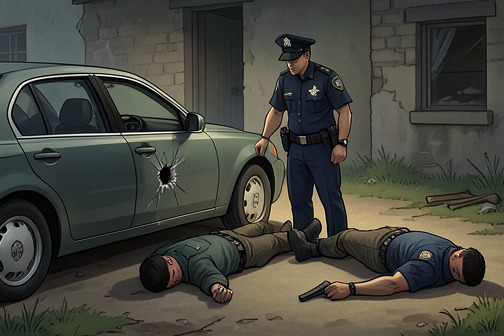
[Lee Bodecker](entity:character-recall-character-lee-bodecker-ef89a6a93f08)’s investigation of [Carl Henderson](entity:character-recall-character-carl-henderson-7a9cb37a060f) and [Sandy Henderson](entity:character-recall-character-sandy-henderson-1a968f15cb32)’s murders becomes a cover-up: instead of preserving evidence and pursuing the killer impartially, he removes incriminating material, misdirects his deputies, and sets out to find [Arvin Russell](entity:character-recall-character-arvin-russell-07e063535b34). His inquiry exposes the murders’ photographic record and links Arvin to the crime, but Bodecker’s loyalties—to his dead sister, his own political ambitions, and his criminal past—corrupt the search from its first hours.
## The scene and its clues
A farmer discovers Carl and [Sandy](entity:character-recall-character-sandy-457b75877fae)’s bodies, then flags down a truck for help. By the time Bodecker arrives on Tuesday around noon, four police cruisers are at the scene and his chief deputy, Howser, has begun managing the response. Bodecker is shaken to find his sister dead. He asks to be left alone with her, examines the scene, and removes a bullet from the car door. The wound and the bullet suggest a nine-millimeter weapon; nearby, [Sandy’s .22 pistol](entity:object-recall-object-sandy-s-22-pistol-406f16415060) has been fired once, but its remaining cartridges are blanks. Carl’s .38 has not been fired. These details tell Bodecker that the apparent exchange of gunfire is misleading: Sandy’s weapon could not deliver the expected live shots, and Carl never fired his.
Bodecker initially performs some ordinary investigative acts. He asks whether the car door was open when the deputies arrived, orders a search of the cornfield, and tells Howser to arrange for the car to be checked for prints. But he also begins taking evidence for himself. While Howser is occupied with the other deputies, Bodecker pockets rolls of film from the open dashboard and removes keys from the ignition ring. He notices a hotel receipt from [Johnson City](entity:location-recall-location-78a8d524e705), dated two nights earlier, and recalls that he saw the couple sixteen days before. In his estimation, they were close to getting home. The receipt and route become part of a pattern he will investigate privately rather than share openly.
A patch of vomit in the grass provides another clue. From its position by the backseat, Bodecker reconstructs a likely arrangement: Carl was outside with his gun, Sandy was in front, and a third person had been sitting behind them. The killer, he reasons, fired three shots before Carl could shoot, then became sick. Bodecker recognizes the reaction from his own first killing for [Tater Brown](entity:character-recall-character-tater-brown-f45d3ec147b4) and concludes that the shooter may be inexperienced at killing but knows how to handle a gun. The deduction is personal as well as forensic: his memory of violence supplies a measure by which he judges the unknown killer.
## Identifying Arvin
A call from a sheriff in [Lewisburg](entity:location-recall-location-969e6808fc05), [West Virginia](entity:location-recall-location-b5f666a6a324), gives Bodecker a name. The young man is Arvin Russell, eighteen, whose parents died in the region and who has lived with his grandmother in [Coal Creek](entity:location-recall-location-coal-creek-dcef26748dc1) for roughly seven or eight years. The caller says Arvin is known locally and suggests that the preacher Arvin killed may have been exploiting young girls, while acknowledging that this would not justify the killing. Bodecker asks for a photograph, then recognizes the name when the call ends. Memories return of Arvin’s prayer log, dead animals, and the boy with pie juice on his face. The apparently distant preacher case and the murders of Carl and Sandy now converge in his mind.
Bodecker traces a route on a map from Johnson City through West Virginia and across [Ohio](entity:location-recall-location-4c66c89ead05) on [U.S. Route 35](entity:location-recall-location-35-c57344d57efe) at [Point Pleasant](entity:location-recall-location-29e37f3e2602), stopping near the area where Carl and Sandy were killed. The route troubles him. Sandy had said she was going to Virginia Beach, yet the stay in Johnson City seems to take the couple out of their way. Their possession of guns also raises questions. He does not yet establish exactly where the couple encountered Arvin, but he sees enough to suspect that the young man is connected to their deaths.
The strongest evidence of what Carl and Sandy had been doing is not at the roadside but in their apartment. Using the keys he took from the scene, Bodecker enters and searches the rooms. At first nothing seems unusual. Then he realizes that there are no photographs on the walls or lying about, an absence that is striking because Carl’s life revolved around his camera. He searches again and finds a shoebox hidden under spare blankets beneath the bed. Earlier scenes establish what makes the discovery significant: Carl carried a Leica M3, used flirtation and staged offers of photographs to draw men into his control, and treated the victims’ final moments as material for his pictures. He kept more than two hundred photographs in a box and repeatedly examined them. At the crash scene, Arvin found a photograph of Sandy with a dead man among the possessions of one victim, took it, and removed two film canisters from the car. The image and film make the private collection evidence of a pattern of killings, not merely a photographer’s archive.
## Evidence turned into a cover-up
Bodecker’s handling of the film and photographs is deliberate. He first takes film from the car while Howser is away; later, after finding the hidden box, he removes the photographs and film from the official investigation. At an old dump on [Reub Hill](entity:location-recall-location-26950fc638dc), he counts pictures of twenty-six different men and sees at least a couple hundred shots bundled together. He adds scraps of a catalog and the film canisters, lights the box, and watches the collection burn. The destruction erases material that could have helped identify Carl’s victims or establish Sandy’s part in the crimes. It also prevents the photographs from becoming public evidence about his sister.
His reasons are mixed rather than cleanly protective. At the scene, he thinks of Sandy as his sister even while judging her appearance and clothing. Later, he cannot bear the thought of everyone learning what she had been doing in some of Carl’s pictures. But he also considers how the Arvin case might serve his political future: the young man could be presented as a dangerous killer, and voters, he thinks, respond to a hero. Bodecker’s concern for Sandy’s reputation, his electoral calculation, and his willingness to conceal evidence reinforce one another. He chooses not to distinguish a search for the truth from a story that might benefit him.
The cover-up extends to his dealings with the department and the town. When asked whether the call from West Virginia relates to the murders, Bodecker denies the connection and describes it as a matter involving a preacher. He then searches for Arvin through [Hank](entity:character-recall-character-hank-79d5809e13b8), confronting the storekeeper with a gun and threatening to frame him for a killing if he refuses to answer. Hank tells him that Arvin mentioned the old house where he used to live. Bodecker leaves with the information, while Hank remains behind, distressed by the threat. The exchange shows Bodecker using the authority of his office and the threat of fabricated evidence to turn a witness into a coerced source.
## Pursuit and significance
Bodecker also tries to shape how other officers approach the search. He tells Howser to send Taylor and Caldwell after the suspect, describing Arvin as someone likely to shoot them. The warning can sound like a precaution, but it is part of a larger effort to keep control of the pursuit while he moves toward Arvin himself. He has already concealed the West Virginia connection, destroyed the photographic evidence, and threatened Hank; his official investigation no longer offers a reliable account of what he knows or intends.
He drives to the property where the Russells once lived, imagining that he might buy the land, build a house, and plant an orchard after the immediate trouble is over. He also considers what Arvin’s case could do for his campaign and for the reputation of Sandy, whose photographs he cannot bear to have exposed. Then he sets those calculations aside long enough to approach the abandoned homestead. He carries a revolver and takes a shotgun from the cruiser, moving carefully from the remains of the house and barn toward the field and tree line. The supplied scene ends with him searching for the path Arvin had taken toward the place where his father died; it does not establish the outcome of this approach.
The investigation’s central reversal is that the sheriff who appears to be solving a double murder becomes an active obstacle to the truth. Carl’s camera had turned murder into a private spectacle, preserving images that outlasted the victims; Bodecker’s destruction of those images extends the violence into the investigation by denying the victims an evidentiary record. At the same time, the clues that remain—the blanks, the unused .38, the vomit, the route, and Arvin’s name—give Bodecker enough to pursue the young man. His investigation therefore advances two conflicting processes: it reveals how Arvin may be connected to the killings, while Bodecker’s own misconduct makes the search less a matter of justice than of concealment and control.
Event 6
Arvin’s return to the Russell homestead and prayer clearing
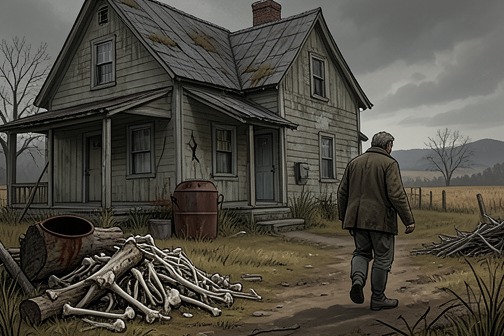
[Arvin’s return to the Russell homestead and prayer clearing](entity:event-recall-event-arvin-s-return-to-the-r-456005274fbf) turns a journey home into a reckoning with grief, memory, and his father’s faith. The house and the clearing have fallen into ruin, but their remaining objects—an old feed bucket, the prayer log, and [Jack](entity:character-recall-character-jack-b5a26722c3ea)’s bones—give Arvin a way to revisit what he had misunderstood. His attempt to pray there again becomes both an act of mourning and the prelude to a confrontation with Sheriff [Lee Bodecker](entity:character-recall-character-lee-bodecker-ef89a6a93f08).
## The journey back
The return begins after Arvin reads that the sheriff’s sister and her husband have been murdered. The newspaper reports that the couple had been returning from Virginia Beach and names no suspect, but it includes a photograph of Lee Bodecker. Arvin recognizes him as the officer on duty the night [Willard](entity:character-recall-character-willard-141299ec5391) killed himself. Alarmed, Arvin packs his belongings, then goes back for the Calvary picture on his motel-room wall. He wraps it in the newspaper carrying the murder report and puts it in his bag: the image that will later be placed at his father’s clearing travels with news of the killings and the sheriff’s connection to his past.
Arvin heads west on foot. A logging truck takes him toward Bainbridge and leaves him at Route 50 and Blaine Highway; he crosses Paint Creek at Schott’s Bridge and reaches [Knockemstiff](entity:location-recall-location-knockemstiff-c2194d5d49ce) about an hour later. Eight years have passed since he left. The landscape is recognizable, though a couple of ranch-style houses now occupy part of what had been a cornfield. At [Maude's store](entity:location-recall-location-maude-s-store-5892af02a831), he finds [Hank](entity:character-recall-character-hank-79d5809e13b8) still working behind the candy case, older and more frazzled. Arvin sets down his gym bag, takes a bottle of root beer, and drinks before continuing toward the old property. This brief stop places his return in the ordinary life of the holler, even as the newspaper and his hurried departure have already set the journey in motion.
## The homestead in ruins
Arvin follows the deer path he once walked with Willard toward the prayer log. The house is gone. He enters where the back door used to be, passes through the kitchen and hall, and reaches the room where [Charlotte](entity:character-recall-character-charlotte-45ddf3085f55) died. He searches the cinders and charred lumber for a keepsake from her or for one of the small possessions he had kept by his bedroom window. Nothing remains except a rusty doorknob and his memories. A neat row of empty beer bottles on the rock foundation marks someone else’s recent presence, but offers no explanation for the absence around it.
The barn has also deteriorated: its siding is gone, and its roof is rusted through. In a corner Arvin finds the feed bucket Willard once used to carry blood. He moves it to the front of the barn and sits on it while eating lunch. The object connects the derelict building to the sacrifices Arvin remembers, but now it is simply a seat in a damaged structure. During this pause he takes out a photograph of a woman with a dead man and considers why anyone would do such a thing. He also wonders how the woman’s bullet missed him at such close range. The photograph remains unexplained in this encounter, but its presence links the violence he has witnessed to the questions he carries back to the old property.
## Revising his memory of Willard
The clearing Willard made is partly overgrown, yet the prayer log and five of the crosses remain upright; four others lie on the ground among trumpet vines. At the first cross, Arvin sees what remains of Jack. The sight brings back the period before Charlotte’s death and Willard’s desperate efforts to keep her alive. Arvin recognizes that his father had been willing to endure the blood, insects, heat, and other hardship involved in his sacrifices for her. Standing in the place that had been Willard’s church, he reaches a new understanding: Willard had believed he needed to go where Charlotte went so he could continue looking after her.
That realization alters Arvin’s long-held judgment of his father. He had despised Willard for leaving him after Charlotte died, as though the boy’s fate had meant nothing to him. Now he recalls the ride back from the cemetery, when Willard spoke of visiting [Emma](entity:character-recall-character-emma-0b5c09f9ac66) in [Coal Creek](entity:location-recall-location-coal-creek-dcef26748dc1) and suggested that Arvin stay there. Arvin understands the suggestion as the closest his father could come to saying that he, too, was leaving and was sorry. The memory does not undo the abandonment Arvin experienced, but it supplies an intention and an apology he had not previously recognized.
Arvin gathers Jack’s remains, including the skull, collar, and bones, and buries them at the foot of the dog’s cross. The small bullet hole in the skull recalls how Jack died, while the burial gives Arvin a concrete act of care to perform in a place shaped by Willard’s rituals. He hangs the Calvary picture from the motel on a nail in the cross. The picture that he carried away from his room now becomes part of the clearing’s arrangement, joining the image of Christ to Jack’s grave and the crosses left by his father.
## Prayer and interruption
After burying Jack, Arvin returns to the other side of the prayer log, where he once knelt beside Willard. He places his Luger on the log and tries to picture God, but his thoughts wander; he finds it easier to imagine his parents looking down on him. He prays for the first time since Charlotte’s death, asking to be told what to do. A gust of wind follows, and bones still hanging in the trees knock together. The moment offers no explicit answer. Instead, the clearing holds prayer and uncertainty together: Arvin has returned to his father’s sacred place, but he cannot make his thoughts conform to the faith that once organized it.
The wind dies, and everyday sounds rise from the holler. When the cicadas fall silent, Arvin thinks he hears a footstep or a twig breaking behind him. He takes the Luger from the log and moves cautiously uphill, then remembers that his gym bag remains beside the prayer log. By the time he recalls it, he has gone too far to retrieve it without turning back. The abandoned bag leaves the crucifix visible at the clearing and gives the approaching sheriff a sign of Arvin’s presence.
Lee Bodecker calls Arvin’s name and identifies himself as sheriff, claiming that he has come only to ask questions and will not hurt him. He carries a shotgun. When a grouse startles him, he fires, then continues toward the brush. At the edge of the clearing he sees Arvin’s bag, the framed Jesus hanging on the cross, and bones in the trees. He recalls the night Arvin brought him to this place and refers to what Willard did there as terrible. Arvin, concealed behind a tree, uses a piece of dead wood as a distraction; Bodecker fires again toward the sound and advances toward the log. The passage ends with the two men closing on one another, before the confrontation’s outcome is shown.
## Significance
The return places two forms of reckoning in the same clearing. Arvin’s inward one is an act of mourning: he recovers a more compassionate understanding of Willard and lays Jack’s remains to rest. Bodecker’s arrival turns that private work into a pursuit, bringing the lawman linked to Willard’s death into the landscape where Arvin has just revised his memory of his father. The ruined house, the surviving crosses, and the abandoned bag make the past materially present, but they do not settle Arvin’s questions or tell him what to do. His prayer ends not with certainty but with an armed encounter beginning at the edge of the place where he once sought guidance.
Event 7
Arvin’s final confrontation with Lee Bodecker
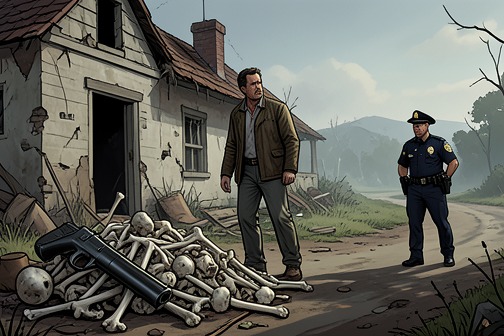
[Arvin’s final confrontation with Lee Bodecker](entity:event-recall-event-arvin-s-final-confronta-99e31eaa26d2) takes place at the abandoned Russell property, where Arvin has returned to pray and Lee has come to hunt him down. Their encounter brings together the sheriff’s public authority and private corruption, the photograph that Lee tried to destroy, and the childhood landscape Arvin is about to leave for good. It ends with Lee dead, the Luger buried beside [Jack](entity:character-recall-character-jack-b5a26722c3ea)’s remains, and Arvin walking away from the place where his family’s history and his own violence have converged.
## Background and Conflicting Motives
Lee approaches the confrontation after a night of drinking and a morning spent burning evidence. At the old dump on [Reub Hill](entity:location-recall-location-26950fc638dc) Road, he set fire to a shoebox containing photographs of twenty-six men and at least a couple hundred images, along with three film canisters. The destruction followed his review of the material; he could not bear the thought of people learning what [Sandy Henderson](entity:character-recall-character-sandy-henderson-1a968f15cb32) had been doing in some of the pictures. His effort to erase the images was therefore not simply an attempt to manage an investigation: it was also an attempt to suppress knowledge about his sister.
Lee nevertheless considered how the case might serve his political prospects. He imagined presenting Arvin as a dangerous killer and using the pursuit to strengthen his chances of winning another election. He also contemplated buying the Russell land and building a house and orchard there. These calculations sit uneasily beside his stated duty as sheriff. He arrives armed with a revolver and a shotgun, with the aim of finding Arvin, while his thoughts turn between ambition, his family, and the job he believes he must do.
Arvin has returned to the property for a different reason. At the place where he once prayed beside his father, he kneels by the log, sets down the Luger, and tries to pray for guidance for the first time since his mother died. The bones hanging in the trees knock together when a gust passes through. After the breeze dies, ordinary sounds rise from the holler; then the cicadas pause, and Arvin hears a possible footstep behind him. He takes up the gun and moves away from the prayer place, leaving his gym bag behind. The return begins as an attempt to face his past, but the approaching sheriff makes it a confrontation.
## The Search at the Russell Property
Lee drives along the dirt lane toward the remains of the Russell home, passing the old foundation and what remains of the barn. He proceeds on foot, looking for the path where he had once followed Arvin. He recalls killing two men for [Tater Brown](entity:character-recall-character-tater-brown-f45d3ec147b4) and feels both fear and excitement as he searches the brush. Three black crows cross the field before he finds trampled weeds and the beginning of the deer path. He follows it downhill with the shotgun ready.
Arvin hears Lee call his name and takes cover behind a hickory tree. Lee identifies himself as sheriff, says he wants to ask questions, and claims that he has not come to hurt Arvin. His actions undermine that reassurance: startled by a wood grouse, he fires the shotgun and reloads. As he moves into the clearing, he sees Arvin’s gym bag, the religious image left near the prayer place, and bones suspended in the trees. Lee interprets the scene as possible evidence that Arvin is unstable, an impression that leaves him poorly prepared to understand why Arvin has returned.
Arvin does not answer Lee’s approach by rushing him. He eases the safety off the Luger and throws a piece of dead wood so it strikes a tree below the prayer log. Lee fires twice toward the sound, then advances. Arvin circles behind him and orders him to put down the shotgun. Lee refuses, invoking the rule that law-enforcement officers do not surrender their weapons. The standoff makes their unequal claims plain: Lee speaks from the authority of his office, while Arvin insists that the armed sheriff is the immediate threat.
## The Photograph and the Shooting
Lee challenges Arvin over the deaths of Sandy Henderson and [Preston Teagardin](entity:character-recall-character-preston-teagardin-659c0b75017e), treating them as evidence that Arvin is a killer. Arvin answers with the photograph he has kept in his pocket. He says it shows [Sandy](entity:character-recall-character-sandy-457b75877fae) holding a dead man and offers to show it if Lee lets go of the shotgun. The image is the same kind of object Lee tried to eliminate when he burned the photographs and film: a record that can outlast the story he wants to tell about his sister and the case.
Lee sees his own likeness on the front page of the morning newspaper lying in Arvin’s open bag. The portrait was taken after his election, a reminder of the official identity he has used while destroying evidence and considering how to manipulate public opinion. He then raises the shotgun and starts to turn toward Arvin. Arvin fires. Lee’s shotgun discharges into the wild roses, and Arvin fires again. Lee falls, wounded; when he tries to reach for his revolver, Arvin takes it away and throws it aside.
Arvin does not leave Lee to die without showing him the photograph. He sets the Luger on the log, turns Lee onto his back as gently as he can, and holds out the image. He explains that he had begged Sandy to put down her gun and had no choice. Lee looks from Arvin to the photograph, which shows Sandy cradling a dead man. He tries to take it but is too weak. In the reversal, the image Lee sought to suppress becomes Arvin’s account of what happened, offered directly to the brother whose grief and concealment have shaped his pursuit.
## Death, Burial, and Departure
Lee takes only a few minutes to die, though to Arvin the wait seems much longer. As he listens, Arvin understands that there is no way to turn back, but also that he cannot continue as he has been. He imagines a door closing on an empty room; the thought calms him enough to make a decision. This pause gives the killing a consequence beyond the immediate end of the chase: Arvin recognizes that his old life, including his reliance on the gun, cannot simply resume.
He retrieves the Luger and goes to the hole he had dug for Jack. Remembering his father bringing the gun home years earlier, Arvin rubs its metal barrel and buries it alongside the dog’s remains. He covers the grave with dirt, leaves, and branches. He then takes down the image of Jesus on the cross, wraps it, and puts it in his gym bag, thinking that perhaps he will have somewhere to hang it someday. The gun and the religious image part ways: one is left with the bones, while the other travels with him.
Before leaving, Arvin puts the photograph of Sandy and the two rolls of film in Lee’s shirt pocket. This is not a return of all the evidence Lee destroyed; the shoebox and three canisters he burned are gone. But the surviving image and film remain with the dead sheriff, connecting Lee’s cover-up to his fate and preserving a record beyond the story he wanted to control. Arvin looks once more at the moss-covered log and rotting crosses, knowing he will not see the place again and probably will not see [Emma](entity:character-recall-character-emma-0b5c09f9ac66) or [Earskell](entity:character-recall-character-earskell-c64bccd61d49) either. He climbs the deer path, enters the bright field, and walks north toward Paint Creek, hoping to reach Route 50 and find a ride.
## Narrative Significance
The confrontation is both a pursuit and a collision between competing versions of justice. Lee has the badge, the weapons, and the public image of an elected lawman, but his destruction of the photographs and his political calculations expose the self-interest beneath that image. Arvin, by contrast, is a fugitive who has killed, yet he brings forward the photograph and asks Lee to see the circumstances of Sandy’s death rather than accept a simplified accusation. The scene does not make Arvin’s violence disappear; it sets his explanation beside the sheriff’s concealed wrongdoing.
The photographs also bind the encounter to the earlier killings committed by [Carl Henderson](entity:character-recall-character-carl-henderson-7a9cb37a060f) and Sandy. Carl treated the camera as an instrument for staging and preserving victims’ deaths, and he argued that a victim’s final terror made a better picture. Lee’s attempt to burn the collection repeats the effort to control what those images mean, while Arvin’s use of one photograph turns the record into evidence in a personal reckoning. The image cannot undo the deaths, and it does not prevent Lee’s, but it changes what can be said at the scene.
The ending separates Arvin from the objects and places that have carried his inherited history. He buries the Luger associated with his father and takes the cross image away from the clearing, then leaves the homestead, the prayer place, and the people still connected to it. His departure offers no assurance about what comes next. It marks instead the close of this pursuit and his attempt to walk beyond a life in which family memory, faith, and violence have repeatedly met.